Updates
Climate
By
Sean Beck
Nov 19, 2025
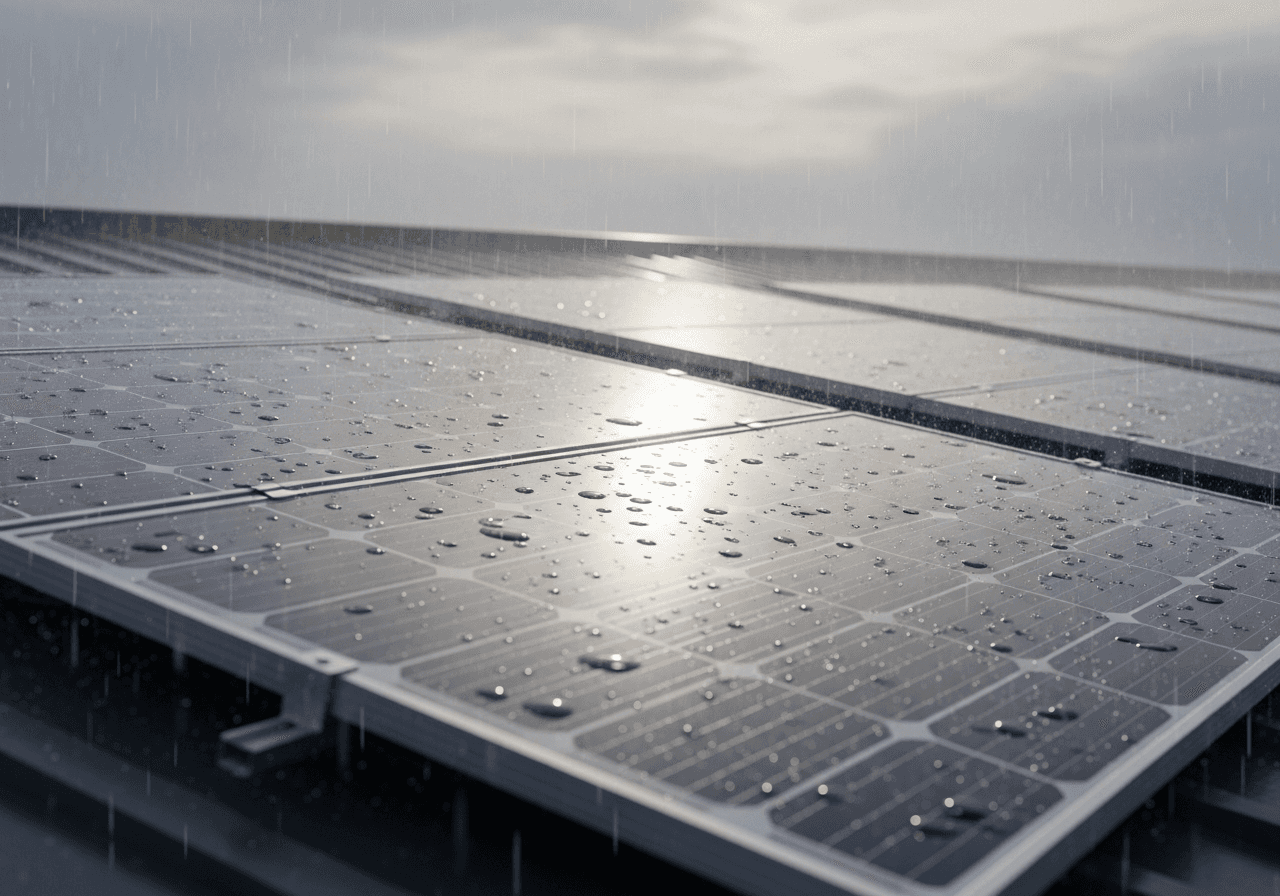
Most people imagine solar panels working at their best under a bright, cloudless sky. Sunlight pouring down, panels absorbing every ray, and clean energy flowing effortlessly into the grid. But the story is far more interesting than that. Solar technology is not limited to perfect weather. It continues working even during rain, clouds, and overcast days, thanks to a natural phenomenon known as diffused light.
When raindrops fall and clouds thicken, direct sunlight becomes scattered in all directions. Instead of hitting the Earth as strong beams, sunlight is spread evenly across the sky. This softer illumination is called diffused light. Although it seems dimmer to our eyes, it still carries energy, and solar cells are designed to capture it. The result is simple. Solar panels continue producing electricity even in the rain, although at a lower output.
This ability comes from the way photovoltaic materials respond to light. Solar cells do not need focused beams of sunlight to generate electricity. They only require photons, the tiny particles of light that remain present even in cloudy conditions. Modern solar panels are highly sensitive to these scattered photons, allowing them to operate in regions known for unpredictable weather. Countries like Germany, the United Kingdom, and Japan, all famous for cloudy climates, remain global leaders in solar power because diffused light still keeps their systems running throughout the year.
Rain also brings an unexpected advantage. It naturally cleans the surface of solar panels. Dust, pollen, and pollution coatings that accumulate over time can reduce efficiency. A regular rainfall helps wash these particles away, keeping panels clearer and improving performance when the sun returns. In some coastal or desert regions, this self-cleaning effect is a significant benefit that reduces maintenance costs.
Of course, energy production during rain is lower than on sunny days. Output may drop to a fraction of peak performance depending on cloud density. Yet solar systems are designed with this variability in mind. Smart inverters adjust production automatically. Energy storage solutions, such as modern battery systems, store surplus electricity from sunny hours and release it during darker periods. Grid connected solar farms contribute consistently across seasons because the global mix of weather conditions balances out over time.
Understanding that solar panels work in the rain changes the way we view renewable energy. Solar power is not fragile. It is resilient, adaptive, and capable of producing electricity under almost any sky. This reliability is why solar power has become one of the fastest growing energy sources in the world. It thrives not only in deserts and tropical regions but also in places where rain is part of everyday life.
Next time you watch rain fall across rooftops and fields, imagine tiny photons still being captured by the panels above. Even in the softest light, the journey of clean energy continues, unaffected by the changing weather. The sun is always present behind the clouds, and solar technology is ready to capture its power, no matter how gentle the light becomes.
Comments