Nature
Climate
By
Sean Beck
Oct 31, 2025
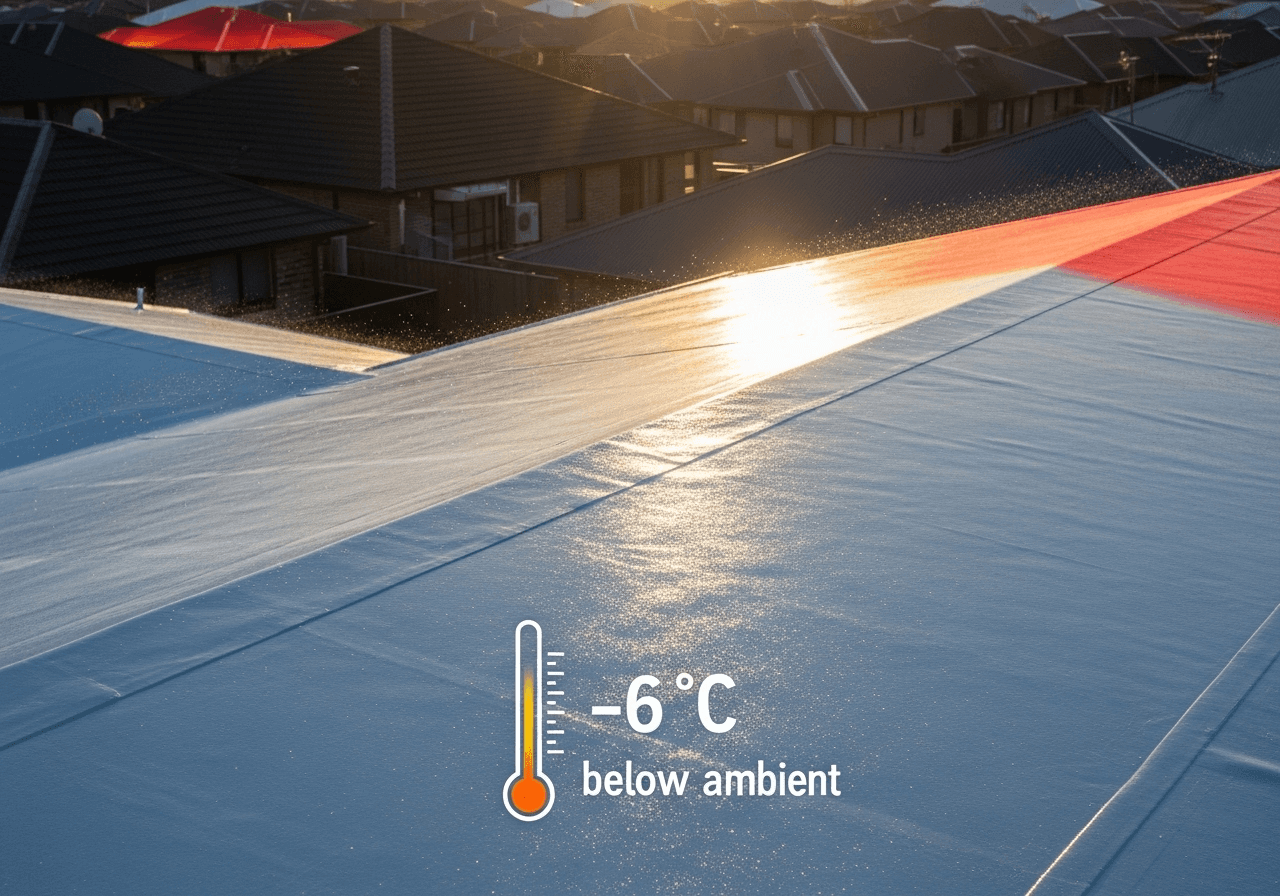
Researchers in Australia have unveiled an advanced roof-coating material capable of lowering roof surface temperatures by as much as 6 °C below ambient air temperature on hot, sunny days. What sets this invention apart is that it works passively, meaning it requires no external power or cooling system: it reflects nearly all incoming solar radiation and emits heat effectively into the sky—thus keeping the roof cooler.
The prototype coating was tested at the Sydney Nanoscience Hub over a six-month period, where it was applied to existing roof surfaces and paired with a thin, UV-resistant topcoat. The material is designed to achieve around 96% solar reflectance, meaning only a small fraction of the sun’s rays is absorbed. Meanwhile, it has high thermal emissivity, allowing heat built up during the day to radiate away even while the sun is shining—a process known as passive daytime radiative cooling.
An additional benefit emerged during testing: the cool surface encouraged condensation from atmospheric moisture, essentially harvesting dew. In favourable conditions, the researchers collected up to roughly 390 millilitres per square metre per day, which for a typical residential roof of about 200 m² translates to an estimated 70 litres of water on suitable days. This dual benefit—reduced heat load and added water capture—suggests strong potential for applications in buildings with poor insulation, remote locations, or regions with limited water access.
According to the lead researcher, the 6 °C drop in roof surface temperature can translate into meaningful indoor cooling for many homes. In poorly-insulated buildings (common in older housing), a cooler roof means less heat transferred downward into living spaces. The coating also holds promise for reducing the urban heat island effect, where built-up areas can be 1 °C to 13 °C warmer than surrounding rural zones because of heat absorbed and re-emitted by roofing and paving.
While the prototype uses a perfluorinated polymer—poly(vinylidene fluoride-co-hexafluoropropene)—which is not ideal for large-scale commercial deployment due to environmental concerns, the research team is already developing a water-based commercial version that retains similar cooling performance while being low-impact and cost-competitive with existing premium roof paints.
Industry experts view this breakthrough as a milestone. Retrofits that let existing buildings reduce their roof-surface temperatures without major structural change are rare. The simplicity of applying a coating paints the picture of an accessible tool in climate adaptation—especially as extreme heat events become more common. Yet, caution remains: actual cooling depends on climate (e.g., humidity, sky clarity), roof orientation and insulation, and the broader building envelope.
In summary, the newly developed rooftop coating offers a multi-functional solution: reducing building heat load, potentially lowering energy use for air conditioning, mitigating urban heat islands, and even collecting water. With further material development and real-world scaling, it might become a practical tool in the fight against rising temperatures and heat-related building stress.
Comments