World
News
By
Sean Beck
Nov 10, 2025
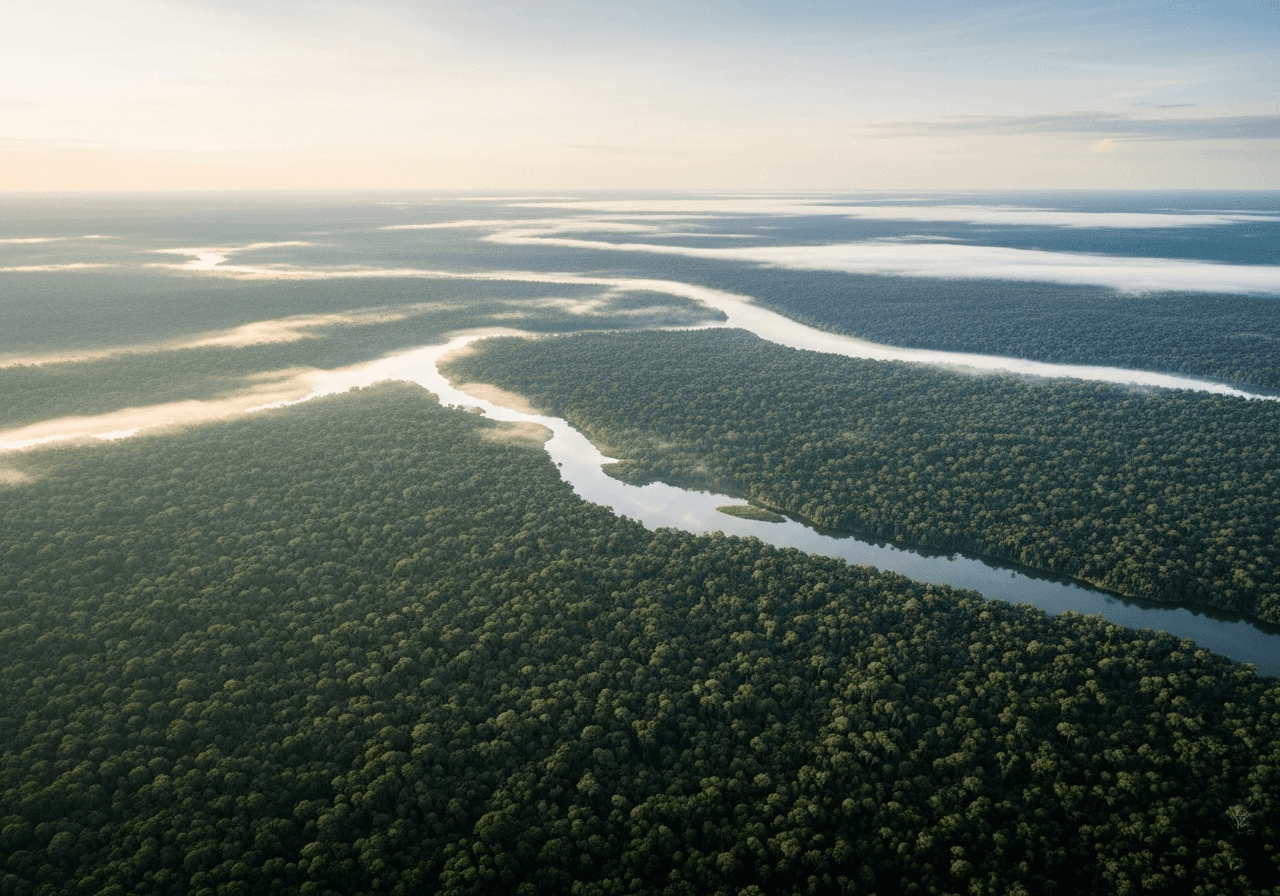
A living sky-machine: how trees pump moisture into the atmosphere, feed regional rains, and why chopping forests can change weather hundreds of miles away.
The Amazon is more than a vast collection of trees — it’s a giant, breathing engine that moves water from soil to sky and then back again. Through a process called evapotranspiration, leaves lose water vapor into the air while soils and rivers evaporate moisture as well. That invisible moisture rises, cools, condenses into clouds, and eventually falls again as rain. In short: the forest helps make the rain that keeps it alive.
Evapotranspiration is the core mechanism. Sunlight warms leaves and soil; trees open tiny pores (stomata) on their leaves to exchange gases, and water vapor escapes. For a mature tropical forest this is not a trickle but a torrent — at the scale of entire watersheds, forests can return a very large fraction of incoming rainfall back to the atmosphere. That recycled moisture travels inland on atmospheric currents, sometimes forming long corridors of humidity that climatologists and local communities have nicknamed “flying rivers.” These moisture streams are crucial for delivering steady precipitation to interior regions far from the ocean.
The interplay of forest, moisture and atmosphere creates reinforcing feedbacks. Tall forest canopy and deep-rooted trees tap groundwater and bring it to leaves even in drier months, sustaining evapotranspiration when simple surface evaporation would falter. Heterogeneous forest structure — a mosaic of mature trees, regenerating patches, and wet soils — encourages cloud formation at lower altitudes, increasing the chance that clouds will produce rainfall locally instead of drifting away. In other words, intact forest helps localize and stabilize rainfall patterns.
But that weather-making ability is fragile. When large swathes of forest are removed, several linked changes occur:
• Less moisture returned to the air. Fewer leaves and a reduced leaf area index mean much lower evapotranspiration. The atmosphere receives less humidity, so cloud formation declines.
• Higher surface temperatures. Open land warms faster than shaded forest, changing local pressure gradients and wind patterns that influence storm formation.
• Altered cloud microphysics. Forests emit organic particles that act as cloud condensation nuclei; without them, clouds can form differently, affecting how and where rain falls.
• Breakdown of moisture corridors. Large-scale clearing can weaken or redirect the “flying rivers,” reducing rains far inland and even altering seasonal rainfall elsewhere.
The practical consequence is stark: deforestation can push a rainforest toward a drier, savanna-like state. Scientists warn of a tipping range in which continued loss of forest cover and increasingly severe droughts could trigger a persistent shift — one that would be extremely difficult to reverse at human timescales. That would not only devastate biodiversity and carbon storage in the Amazon, but also disrupt rainfall for agriculture and cities across South America.
There are also seasonal and teleconnected effects. Moisture exported by the Amazon helps sustain rainfall across the continent; changes there can influence the timing and intensity of wet seasons in regions that depend on this inland moisture supply. Even ocean-linked weather (like the behavior of the South American monsoon or distant storm tracks) can feel the knock-on effects when the forest-atmosphere engine falters.
So what does this mean for policy and action? A few clear lessons emerge:
• Protect intact forest first. Preserving large, connected tracts maintains the hydrological feedbacks that generate and stabilize rain.
• Restore strategically. Reforestation and natural regeneration in key headwaters and corridors can help rebuild moisture recycling and larval connectivity for ecosystems.
• Adopt sustainable land use. Agroforestry, reduced-impact logging, and mosaic landscapes that keep canopy connectivity blunt the worst hydrological impacts of conversion.
• Support Indigenous stewardship. Indigenous and traditional communities often manage forests in ways that preserve ecological function and water cycling. Their land rights and leadership are vital.
• Invest in monitoring and early warning. Remote sensing and ground networks can detect shifts in evapotranspiration, soil moisture and cloud patterns early enough to inform policy and local adaptation.
• Link climate policy with land policy. Global climate goals depend on both cutting emissions and defending the world’s major carbon-and-water reservoirs, like the Amazon.
The Amazon’s ability to make its own rain is a vivid reminder that ecosystems are active planetary players, not passive backdrops. Protecting that living plumbing system preserves biodiversity and carbon storage, yes — but it also protects the very rains that millions of people, farms and cities rely on. In a warming world, keeping the forest standing is as much about securing water and weather as it is about conserving trees.
Comments