Nature
World
By
Sean Beck
Nov 21, 2025
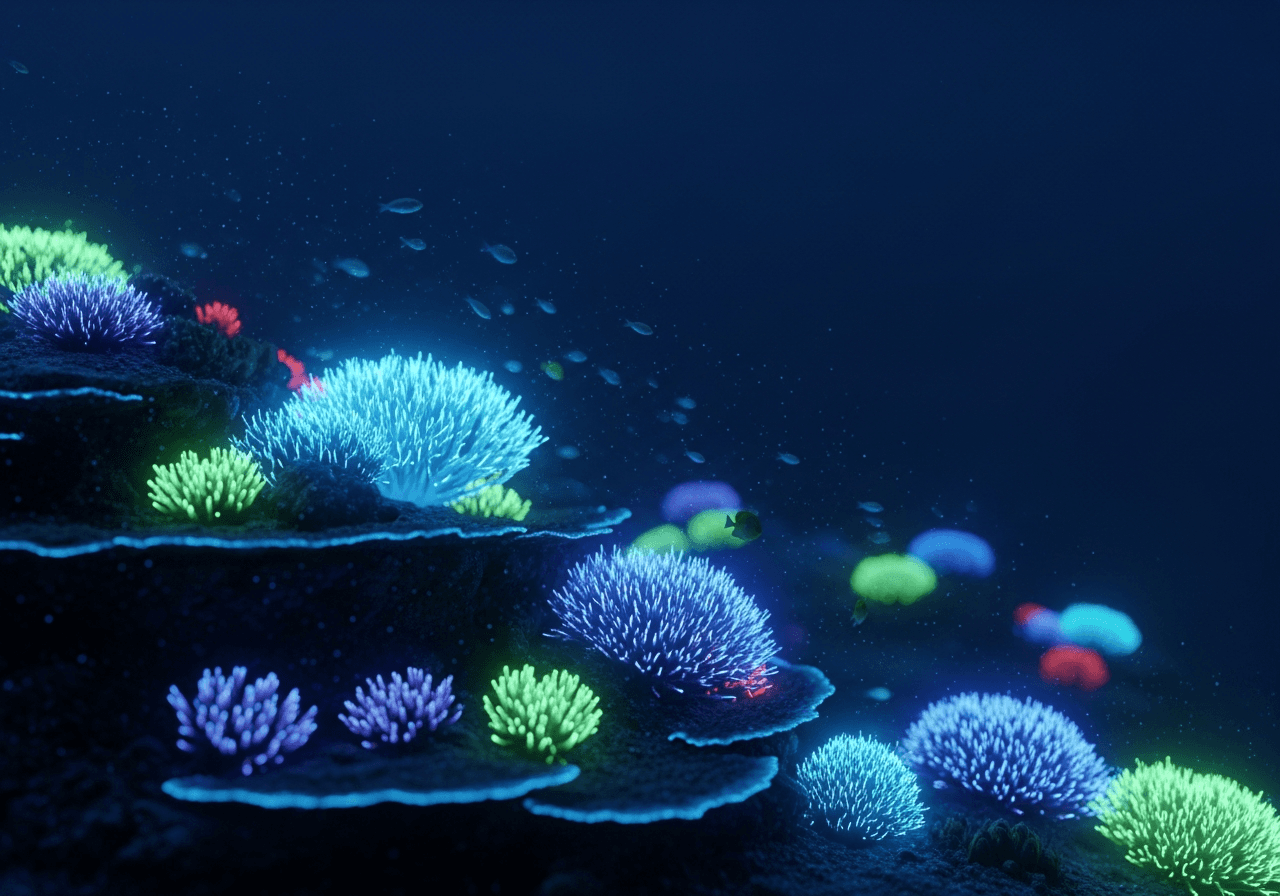
Under the surface of tropical oceans, coral reefs create one of the most vibrant ecosystems on the planet. During the day, sunlight scatters across colorful corals, fish weaving between branches and shadows dancing across the seabed. But at night, something extraordinary happens. Some corals begin to glow, radiating soft blue, green, or neon-like hues that pulse gently through the water. This glow is not just a beautiful trick of nature. It is a survival response.
Corals glow in the dark because they produce special fluorescent proteins that act like protective shields. When ocean temperatures rise or sunlight becomes too intense, corals experience stress. Their tissues heat up. Their symbiotic algae become unstable. Their cells face damage from excess light. To reduce that stress, corals release fluorescent pigments that absorb dangerous light wavelengths and convert them into safer, softer colors that scatter through the water. The glow is a form of natural sunscreen that helps them survive in increasingly harsh conditions.
In healthy reefs, this glowing effect is subtle and serene. In stressed reefs, it becomes much brighter, almost like a warning signal. Scientists call this phenomenon coral fluorescence. It is one of the earliest signs that a reef is under heat stress and may soon begin to bleach. Bleaching occurs when corals lose the algae that provide them with both color and energy, turning them ghostly white. Fluorescence sometimes appears right before bleaching, giving researchers a chance to monitor reef health before the damage becomes irreversible.
This glow is more than a visual spectacle. It plays a critical role in protecting one of the most biodiverse habitats on Earth. Coral reefs support a quarter of all marine species. They shelter young fish, stabilize coastlines, and serve as natural barriers during storms. Their ability to resist heat stress through fluorescence is essential for maintaining life across entire marine food webs.
Yet the rising temperature of the oceans is pushing corals beyond their limits. Fluorescence is a last line of defense, not a permanent solution. If heat exposure continues for too long, even glowing corals cannot prevent bleaching. Entire reef systems can collapse, leaving behind silent underwater ruins where vibrant life once thrived.
Despite the urgency, there is hope in the resilience of corals. Researchers are studying fluorescent species to better understand their natural defenses. Some conservationists are experimenting with coral gardening and selective breeding to increase heat tolerance. Local communities are restoring damaged reefs. And global efforts to reduce emissions are slowly shaping a future where reefs have a better chance to survive.
To see a reef glow is to witness nature using one of its most delicate and beautiful strategies for survival. It is a reminder that even the smallest organisms fight fiercely to protect their place in the world. As the oceans change, these glowing signals tell us that the reefs are calling for help. The question is how quickly we choose to respond.
Comments